
What acetone cleaning actually costs
A lamination shop replaced acetone with a water-based cleaner and measured the cost for four weeks. The figures, where the saving came from, and two things that got worse.
Nobody counts acetone. It gets ordered, it stands in a drum, and no one asks how many litres go through it in a year. One lamination shop did the sum — and then spent four weeks measuring what happens when it replaces acetone on a single job.
What was measured
The company makes panels for rail vehicles. The rollers used to apply polyester resin were cleaned with acetone, and that took 400 litres a month. Another hundred litres went on other cleaning around the shop.
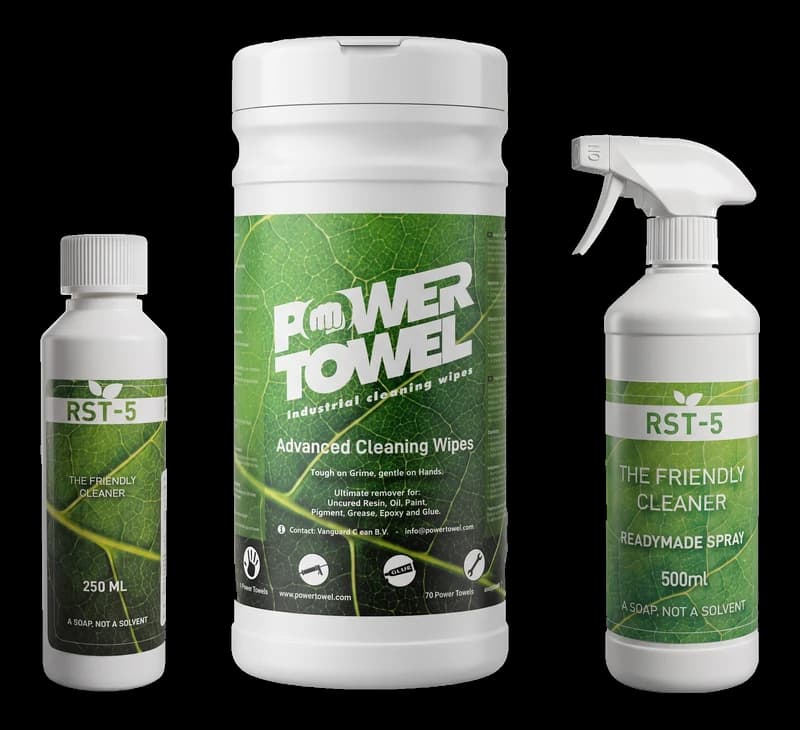
That one job moved to RST-5, a water-based cleaner. It dilutes twenty to one, the bath runs at 40 °C, parts go in and mechanical agitation does the rest. Nothing that needs the shop rebuilt — a thirty-litre heater and a tank.
The monthly figures
| Item | Acetone | RST-5 |
|---|---|---|
| Material | €400 (400 l) | €100 (5 l) |
| Labour | €14 (1 h) | €28 (2 h) |
| Waste disposal | €70 (100 l) | — |
| Water and power | — | €2 |
| Total | €484 | €130 |
Four-week trial, one workstation. Material, labour and disposal at Czech market rates, 2026.
That is €354 a month at a single workstation. €4,248 over a year.
Where the saving came from
Almost all of it from material. Five litres of concentrate against four hundred litres of solvent is an eighty-fold difference in consumption, and it accounts for 85 % of the total saving.
The reason sits in how each one works. Acetone dissolves the contamination and leaves with it — it is consumed. RST-5 breaks the bond to the substrate and the polymer chains; the material lifts off, settles, and the bath carries on working. The settled residue can be filtered out.
The second item is disposal. Taking waste solvent away costs around twenty Czech crowns a kilogram, which on a hundred litres is close to €70 a month. That item disappeared entirely.
Includes the hundred litres of acetone a month still used on other jobs.
What got worse
Handling takes twice as long. The bath needed two hours of work a month against one with acetone — heating, watching, topping up, filtering now and then. In money that is €14, trivial against the saving, but it is real time in somebody's week.
Acetone did not leave the shop. The remaining hundred litres a month still go on jobs where RST-5 is not enough — above all where the resin has already cross-linked. A water-based cleaner will not strip cured laminate. Tools have to be cleaned sooner, and that is a change in habit, not in budget.
What to take from it
This is one workstation in one shop. Your figures will differ — different consumption, different labour rate, a different acetone supplier. What does transfer is the method:
- How many litres of solvent a year actually go through one specific job. Not the whole shop — one job, because that is what gets replaced.
- What disposal costs. It tends to be the item nobody files under cleaning, and with solvents it is not small.
- How much extra handling time it will take. A water bath does not run itself.
When the first two clearly outweigh the third, it is worth trying. When they do not, acetone remains a legitimate choice — it should just be a decision rather than a habit.
Figures come from a four-week trial period. Material, labour and disposal prices reflect Czech market conditions in 2026, converted at 24.20 CZK/EUR. No claims can be derived from these values — another shop will see different numbers.